Hacker Review of Neuromancer, the novel (1984)
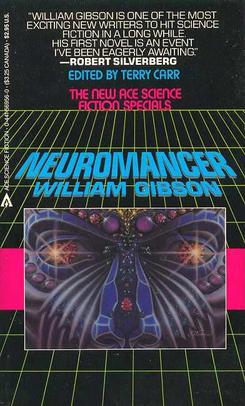
The original cover of the novel.
Neuromancer – the foundational novel of cyberpunk. It's the first and only book to win all three of the Hugo Award, the Nebula Award for Best Novel, and the Philip K. Dick Award.
William Gibson published two short stories in 1981 that set him up for Neuromancer in 1984. I reviewed Johnny Mnemonic in 2021. That's where he introduces Molly Millions. I also reviewed Burning Chrome the same year, where he establishes the Sprawl and cyberspace.
Spoiler alert! Yes, this review contains spoilers.
Hacker Rating
Hacker Realism: ⭐️ ⭐️
Hacker Importance for the Plot: ⭐️ ⭐️ ⭐️ ⭐️ ⭐️
Hacks: ⭐️ ⭐️ ⭐️ ⭐️
A Few Notes on Gibson's Writing
I want to touch on writing style since Neuromancer isn't just great cyberpunk, it's great fiction, period. Take the novel's second sentence:
"It's not like I'm using," Case heard someone say, as he shouldered his way through the crowd around the door at the Chat.
It names the main character and establishes him as male on the fly. Introducing a protagonist is always a challenge, and there are tropes to avoid, such as them looking at themselves in a mirror as an excuse to describe how they look. We don't know much about Case's looks, and we don't need to.
The end of the second paragraph:
The Chatsubo was a bar for professional expatriates; you could drink there for a week and never hear two words in Japanese.
In a single sentence, Gibson establishes that we're in Japan and that Case is a foreigner. He also indicates long drinking sessions and lots of chatter.
Finally, at the games arcade:
Someone scored a ten-megaton hit on Tank War Europa, a simulated airburst drowning the arcade in white sound as a lurid hologram fireball mushroomed overhead.
Many writers have these scenes in their minds. We see them. It's tempting to try to get as much of that vision onto the page. But Gibson masterfully avoids describing Tank War Europa. This means we all get to envision it for ourselves and it draws us deeper into the experience that's so unique to reading. We're not served the picture, we are invited to create it.
The Opening Scene's Blend of Old and New
The expats are served draft Kirin. While that is still a popular beer, it doesn't sound right for a place like the Chat with today's eyes. I'd expect more flavorful beer or something to vape. Kirin also doesn't come across as grimy if that's the desired impression.
The reference to a dead channel on the TV is very 80s. Then we got cable and now streaming. I've been a cord cutter since 2014 and our kids have never seen the static of a dead channel.
This isn't me dissing Gibson, just a reflection on how realism changes over decades. As an author of near-future fiction, you have to choose between made up things or grounding your readers in realism. The way my characters use web search in Identified already feels a bit dated given today's chatbots, and I described futuristic search!
There is a bigger picture here. The punkiness in cyberpunk needs to be decaying, grimy, zip-tied, and edgy. And that's not futuristic to me, unless one means a post apocalyptic future. Cyberpunk should be both old and new, and Kirin may be to what we regress.
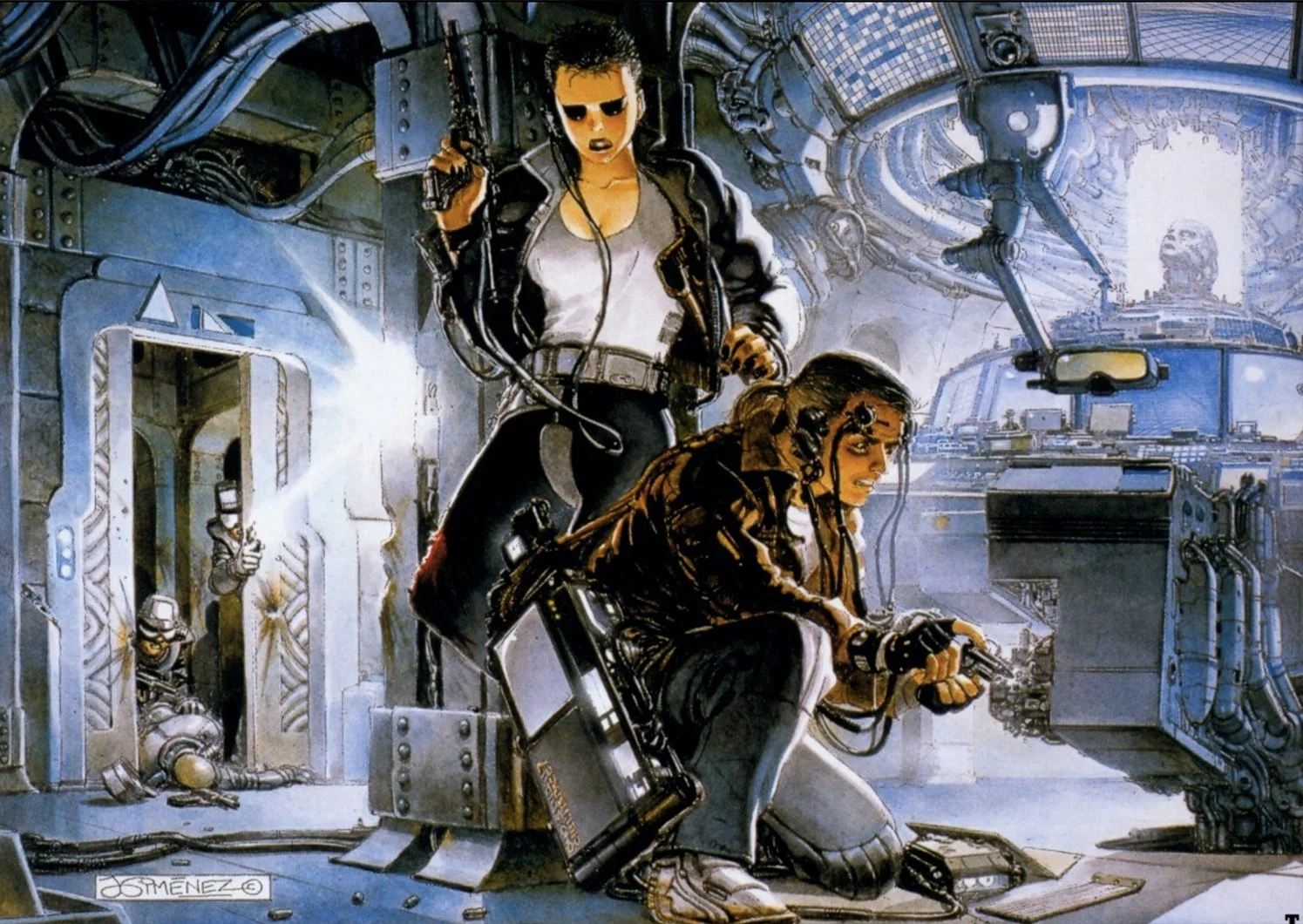
Cyberpunk painting by Juan Gimenez.
A Former Cyber Cowboy
We learn that Case was once a skilled hacker with custom hardware access to a virtual cyberspace.
At twenty-two he'd been a cowboy, a rustler, one of the best in the Sprawl (…) jacked into a custom cyberspace deck that projected his disembodied consciousness into the consensual hallucination that was the matrix.
But he skimmed money behind his employers’ backs and they took their revenge.
Because—still smiling—they were going to make sure he never worked again. They damaged his nervous system with wartime Russian mycotoxin (…) his talent burning out micron by micron
Now he's hustling in Chiba, convinced that he could cure his nerves in Japan but they would never accept his paper New Yen.
The Drugs and Dirt
The characters around Case, and himself, are sweaty, dirty, and either high on drugs or drunk. Only those giving orders rather than taking them are dressed in suits and don't reek of going unwashed.
Threading his way through the Ninsei crowds, he could smell his own stale sweat.
The grime of cyberpunk.
Hacker culture has long been laced with drugs. Mr. Robot incorporated that aspect. But there's a balance between getting high as escapism and enhancing one's senses. Case is not getting wasted; he needs his octagons to keep going. I talked about this in my "Hacking Genes and Brains" newsletter issue in 2022.
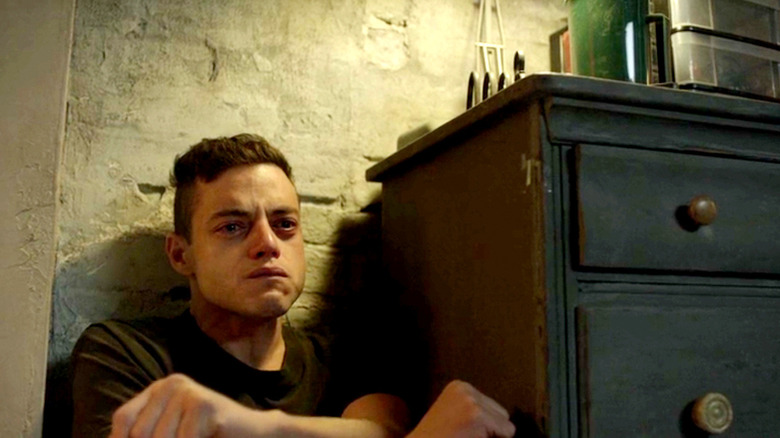
Elliot in a drug use scene of Mr. Robot.
A Second Chance
Molly finds Case and takes him to Armitage, a wealthy man who knows Case’s past. He wants Case back at full capacity for a job in the matrix. Case used to be an icebreaker – breaking ICE, Intrusion Countermeasures Electronics.
You might recall how the burning in Burning Chrome is about breaking ICE. From my review:
Jack has gotten his hands on a Russian military virus so capable that they have to hold it back. They ride in like cyber cowboys and tear down initial defenses before they reach Chrome’s heart. The heart is defended by black ice – ice that kills – only defeatable by the Russian virus.
Case is offered treatment that will reverse the damage to his nervous system, fix his pancreas and liver after all the drugs, and get him ready to jack in again.
Case accepts.
This is a classic story — a broken hero of the past being brought back for one last job.
Motivation and a Ticking Clock
Armitage has cured Case but keeps him on a tight leash. Armitage tells him:
You have fifteen toxin sacs bonded to the lining of various main arteries, Case. They're dissolving.
When Case asks how long, Armitage says:
You have time to do what I'm hiring you for, Case, but that's all. Do the job and I inject you with an enzyme that will dissolve the bond without opening the sacs. Then you'll need a blood change.
This is strikingly similar to how the character Snake Plissken is forced to take on his dangerous mission in Escape From New York.

The character Snake Plissken gets injected with micro-explosives.
Escape From New York was released in July 1981. Gibson's Burning Chrome was first read aloud by Gibson himself at a convention in Denver in the autumn of 1981, and Neuromancer didn't come out until 1984. So Escape From New York was first. The Wikipedia article on Neuromancer also says "John Carpenter's Escape from New York (1981) influenced Gibson's approach to world-building".
This you-will-automatically-die-unless-you-help-me setup is a forcing function which solves two things for authors. First, it motivates the main character to take on huge risks, and second, it adds a ticking clock. Today, I'd say it's viewed as a trope.
The Love of the Machine
I saw you stroke that Sendai; man, it was pornographic.
This is Molly talking to Case after he gets a maxed-out terminal to connect to cyberspace. I can relate. It takes me back to the 1980s when I dreamed of owning a computer. I would go to electronics stores and touch the computers on display. I later got an Atari ST and then an Amiga 500. Lucky me!
Japan's Stature
There are several references to Japan in the book, for instance Mitsubishi Bank of America in cyberspace.
Neuromancer was written during the heyday of Japan as an economic and industrial superpower. The US was afraid of being surpassed and losing, for instance, its car industry. Japan's economy eventually came crashing down in the Japanese asset price bubble leading to what was first the Lost Decade (the 1990s) but became the Lost Decades.
Mitsubishi in particular has a subsidiary called Mitsubishi Estate which has the most valuable portfolio in the Japanese real estate industry.
.png/500px-三菱地所本社ビル(大手町パークビルディング).png)
Mitsubishi Estate HQ.
Asian influence on cyberpunk is profound, and the success of Japan during the era when we got pocket calculators, digital watches, and home computers was a big part of that.
A similar anxiety today centers on China.
The Privacy Room
Case and Molly need to talk about what Armitage is up to. But they realize he is probably monitoring them. So Molly pays for an off-the-grid privacy room.
This makes me think of the listening assistant devices many of us have at home today. But I also recall the precautions Edward Snowden took when meeting with journalists at The Mira Hotel in Hong Kong. The most striking was that all mobile phones had to be powered off and placed inside the hotel room's refrigerator, effectively a Faraday cage.

The Mira Hotel in Hong Kong.
Gibson was very right about how hard it is to maintain privacy today. Even if you have made good choices about your devices and services, what choices have others around you made?
Interfacing With the Digital World
Cyberspace is typically described as a graphic representation of data, entities, and communication. Neuromancer certainly has that going with a clear visual interface and Gibson's description of ICE. I suspect the idea comes partly from computer games.
In reality, we often find ourselves using textual computer and network interfaces. Think of web search, messaging, and chatbots. Text as silent, succinct communication is both efficient and convenient. I love how such an old medium keeps proving itself.
But interfaces change and seem to move in waves. Text, images, audio, video, 3D. The fidelity of each improves over time. You might think that text has been static but just think of the rise of emoji!
Hacking as a graphical experience is still way off. It's still textual except for the means of tricking humans with visuals.
Stealing Dixie Flatline's Construct
We get a three-pronged heist against Sense/Net to steal the construct of a legendary hacker named Dixie Flatline.
-
Case hacks Sense/Net's ICE, Intrusion Countermeasures Electronics.
-
The Panther Moderns, a cybernetic street gang, create a diversion with an alleged biochemical attack on Sense/Net's ventilation system and fake terrorist attack at Sense/Net's HQ.
-
Molly breaks into the Sense/Net's vault to physically steal the construct.
We learn that the construct is a static representation of the human who used to be Dixie Flatline. It's strikingly similar to today's large language models. A model trained in a certain moment in time with immense skills from that time but no ability to learn or change beyond that. The construct is a computer version of what the hacker Dixie Flatline was capable of and Armitage wants it as a copilot for Case when they attempt the big hack.
Case is able to see what Molly sees through a "simstim." It's unclear to me how that high bandwidth connection can work when she's deep inside the corporate vault.
Case's hack is vividly described as involving multiple steps of ice breaking. No surprise. Real hacking involves a lot of discovery along the way unless the hacker effectively has blueprints of the technical setup of the system under attack. Case does not have a blueprint, so the assumption here has to be that he develops each step of the hack before they execute the heist. Otherwise, it would be impossible to hack that quickly.
Wintermute and Colonel Corto
An AI called Wintermute reaches out to Case. He brings it up with Molly who thinks there's a connection with Armitage. She wants Case to investigate.
Case teams up with Dixie Flatline and hacks into Armitage's system in London. They discover some of his background. Armitage seems to have once been Colonel Willis Corto and part of the same hack against Russia where Dixie died. Corto was badly injured but saved so he could testify on what had happened. Once he had told his story, he was cast aside and became the bitter, underground force known as Armitage.
The government resurrecting a brain from someone who succumbed on duty reminds me of the movie Source Code which I reviewed in 2023.
Going Into Space
After the successful heist, Armitage violently recruits a man named Riviera in Istanbul to complete his team for the big one.
They head to a space station, or a cluster of them, called Freeside. Up there, they're getting ready to hack a conglomerate called Tessier-Ashpool, which seems to be Armitage's ultimate goal.
Wintermute is desperately manipulating both Case and Molly to go against Armitage or compromise the Tessier-Ashpool hack.
Psychedelic Scenes
Neuromancer really is a two-part novel. One part cyberpunk, one part loopy space sci-fi.
I'm impressed by Gibson's imagination, creating cyberspace and the mind-bending space stations. I even speculated that Gibson might have been on psychedelic drugs to produce these scenes. But from what I can find, that really wasn't the case.
Here's a quote published by Vice:
“My drug of choice during the composition of Neuromancer, was O'Keefe's Extra Old Stock Lager, a central nervous system depressant, employed primarily to manage the anxiety of composition, and not a practice I'd particularly recommend to anyone considering taking up writing.”

Gibson has also talked about what he was trying to achieve with the speculative setting of Neuromancer. Here's from a transcript of an interview at the New York Public Library on April 19, 2013 (pdf):
I wanted the evocative—evocation is an important part of science fiction and fantasy for me. The calling, if only calling the image of something unreal into being in the reader's mind for a moment has always seemed to me to be like a great hack, it's a fun thing to do if you can, if you can do it, so I was evoking, I was evoking that, but there really wasn't any particular part of me that was like, “Oh, I really want this to happen, I really want this equipment, I want these machines.” That wasn't it. I wanted to induce something in the reader, but it came as a sort of shock to me when I started to meet people whose relationship to my first novel was like, “Holy shit, I want all this stuff right now. Why is my computer so slow?”
Molly's Backstory
Up in space, the team gets ready for the Tessier-Ashpool hack, on Armitage's command. Riviera annoys the heck out of Molly at a fancy restaurant with a holographic, sexual show, depicting her. She leaves Case and isolates herself to get ready for the final assignment.
Case finds her in a different hotel and she shares how she became what she is. There's backstory that Gibson had already published a couple of years earlier.
You might recall my review of his short story Burning Chrome, where I wrote: "Chrome launders money for organized crime and runs a brothel where women can submit their bodies to customers while mentally checking out."
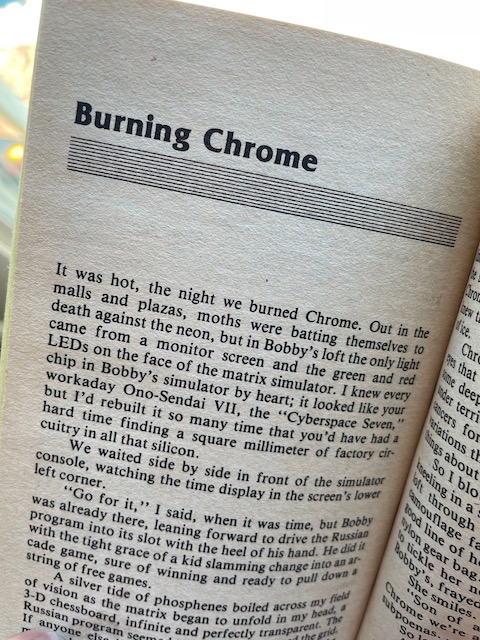
The first page of the short story Burning Chrome.
Molly tells Case that she used to be one of those prostitutes working for Chrome. But the sex work started bleeding into her dreams, giving her nightmares of horrible, deprived things.
She used the money she earned as a prostitute to enhance her body cyborg-style. That's how she got her retractable razor nails. Chrome caught wind of it, installed some bad software in her, and started renting her out for illegal sessions at eight times the price. Eventually her "cut-out chip" flaked out in a session where a senator was murdering another woman. She used her cyborg capabilities to kill the senator and had to go into hiding with a price on her head.
A few chapters later, Molly tells Case that he reminds her of an old boyfriend named Johnny. That's Johnny Mnemonic from the short story and movie of the same name! See my 2021 review. We learn that Johnny was eventually killed for what he did in that story.
In the movie Johnny Mnemonic from 1995, the woman who helps him is called Jane. But she's Molly Millions in the short story and the same Molly in Neuromancer.

Johnny Mnemonic (Keanu Reeves) and Jane (Dina Meyer) in the movie.
Molly's past is of course super dark, but it fits into the tragic state of things in Chiba. It's likely that sex workers would want to use cut-out chips if they existed in real life.
I love how Gibson weaves in two of his original cyberpunk stories into Neuromancer. The series later referred to as The Sprawl was coming together.
Blanking out memories reminds me of the Oscar-winning movie Eternal Sunshine of the Spotless Mind starring Jim Carrey and Kate Winslet. It is dark in its own right. Gosh, it was a long time since I saw that movie.
The Chinese Virus
Kuang Grade Mark Eleven, the military-grade virus, or icebreaker. It's the tool Armitage acquires for Case and the Dixie Flatline construct. It's a slow virus that needs hours to crack a military target or an AI.
I've been thinking about what makes a hack slow. It could be an exhaustive search of a key space to break encryption. But that doesn't feel like a virus. There are also denial-of-service attacks that take time, such as Slowloris. That sounds more like it, slowly eating up more and more of the ice's capacity until it can't detect the real attack that's coming. Another variant of such a denial-of-service attack is the billion laughs attack where self-referencing makes a small data structure blow up in memory size.

Slowloris running on Command Prompt.
The Tessier-Ashpool Family
The target of The Straylight Run hack is the compound and reign of the Tessier-Ashpool family. Ultra rich, self-isolating, and hoarders of human culture.
The mother in the family was the one who created artificial intelligence to run things. She's long dead. The father has frozen himself to get eternal life and wakes up now and then to check in on things. At least that's my understanding but Gibson's compressed, psychedelic writing bends things.
While there are super rich families who like to distance themselves from the 99%, I don't think control over powerful technologies has fallen in the hands of families. It's individuals and companies. Probably armies too, although a lot of that technology is secret.
Two Artificial Intelligences
As The Straylight Run unfolds, i.e. the final hack, we learn that there's a second AI called Neuromancer. The AI called Wintermute is the planning and scheming one who sets up Armitage, Molly, Case, and Riviera to hack Villa Straylight. The AI called Neuromancer represents personality and emotion. Wintermute is compelled to unite with Neuromancer which is the ultimate goal of the hack.
As the final scenes progress, it really is the Wintermute AI that drives the plot. Molly, Case, and Case's Rastafarian companion, Maelcum, are merely vessels needed to perform the physical intrusion.
AI communicating and scheming with other AI is featured in Colossus: The Forbin Project, where two superpower AIs start communicating (see my newsletter review from 2022).
AIs fighting each other also exists, for instance in Terminator 2: Judgment Day.
Underlying is the endless fear we have of the machines taking control.
"He Never Saw Molly Again"
Gibson has said that he added the novel's final sentence "He never saw Molly again" to prevent himself from writing a sequel.
Both reading that sentence and hearing Gibson's reason for it makes me sad, but sad in a rewarding way! Fiction has too few such moments. Emotional finality. I already know the final moment for my lead character West. I've known it since well before I was done with my first novel. It will be the end once I write it.
Take the way Frodo sails away in the end of The Return of the King, and we know he'll never see Sam or the Shire again. That's sad and beautiful.
That's why I'm still upset with how the movie Source Code ended. Some of you might recall that I refused to cover the ending in my review.
The Shuriken Fourth Wall
I wanted to comment on a small narrative thing.
Case desires a throwing star weapon called a shuriken, and Molly gifts him one early in the book. That is the metaphorical "hang a gun on the wall," which according to the rules of fiction writing needs to be fired later in the story for the setup to pay off.

Different types of shurikens.
But Case never uses his shuriken! Even though Gibson reminds the reader of it repeatedly, for instance that it's lying in his pocket. You keep thinking there will be a scene where he's about to die and then pulls off a great comeback with the shuriken, but no.
In the final scene, Gibson instead kind of breaks the fourth wall, at least for us fiction authors, by Case explicitly saying he doesn't need the shuriken. He ultimately throws it into the wall screen but that's utterly underwhelming.
This made me think of Neal Stephenson's totally fourth wall-breaking name of the main character in Snow Crash: Hiro Protagonist, pronounced "Hero Protagonist." That still messes with me.
Final Thoughts
I've mentioned it several times – Gibson's writing is very compressed. It takes focus to read and absorb. I tried to listen to Neuromancer as an audiobook years ago and it didn't work. There's even some of Hemingway's iceberg theory applied, where the reader is given just enough to fill in the blanks and understand what's going on.
What I call the psychedelic space part of the story is pretty far from my own writing. I'm very concrete and realistic in comparison. I do like the dirty Chiba part of Neuromancer better. That's the kind of dystopic tech-infused future I love in cyberpunk.
It's nothing short of stunning how far ahead Gibson was in envisioning the future back in 1983 when he wrote the novel. A lot of it has happened or is happening. Some is still a vision, like the simstim. The only central thing he didn't envision was cellphones, which he has commented on.
Looking at the wave of great hacker fiction that came out around that time, it's not surprising that Gibson managed to synthesize it all into this one novel:
- 1980: The Cyberpunk short story by Bruce Bethke, coining the genre's name
- 1981: Gibson's short stories Burning Chrome introducing cyberspace, and Johnny Mnemonic setting the stage for the Sprawl
- 1982: Blade Runner exploring human-like machines, and Tron taking humans into a virtual world
- 1983: War Games with a hacker as the hero, featuring the love of the machine
- 1984: Neuromancer
On January 22, 2027, Apple TV will launch Neuromancer. I'm really looking forward to it!
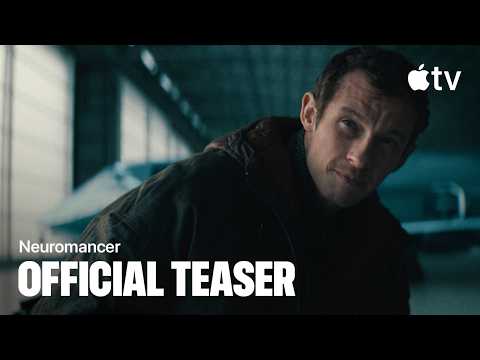
Official Neuromancer teaser on YouTube (click the image to go there).
This text was originally published in my Hacker Chronicles newsletter. Subscribe below!
Get the Monthly Newsletter
Subscribe to the Hacker Chronicles newsletter and don’t miss out on movie reviews, hacker insights, publishing updates, and research for upcoming books.
Hitting subscribe will take you to the Buttondown service provider which hosts the newsletter. You can also go to subscribe.hackerfiction.email.